
2026 Dynasty Trade Value Chart: Superflex and 1QB Rankings by Position
2026 Dynasty Trade Value Chart: Superflex and 1QB Rankings by Position
Last updated: August 12, 2026. Updated weekly through the NFL season as injuries, depth chart changes, and camp news move the market.
Heading into the 2026 season, Ja’Marr Chase is the top asset in 1QB dynasty leagues, with Jaxon Smith-Njigba and Puka Nacua right behind him. In Superflex leagues, the board flips to quarterbacks first. Josh Allen and Drake Maye anchor the top tier, followed closely by Jayden Daniels, Lamar Jackson, Jalen Hurts, and Joe Burrow.
The 2026 rookie 1.01 is Jeremiyah Love, the Arizona Cardinals running back. He sits in a tier of his own in most rookie drafts.
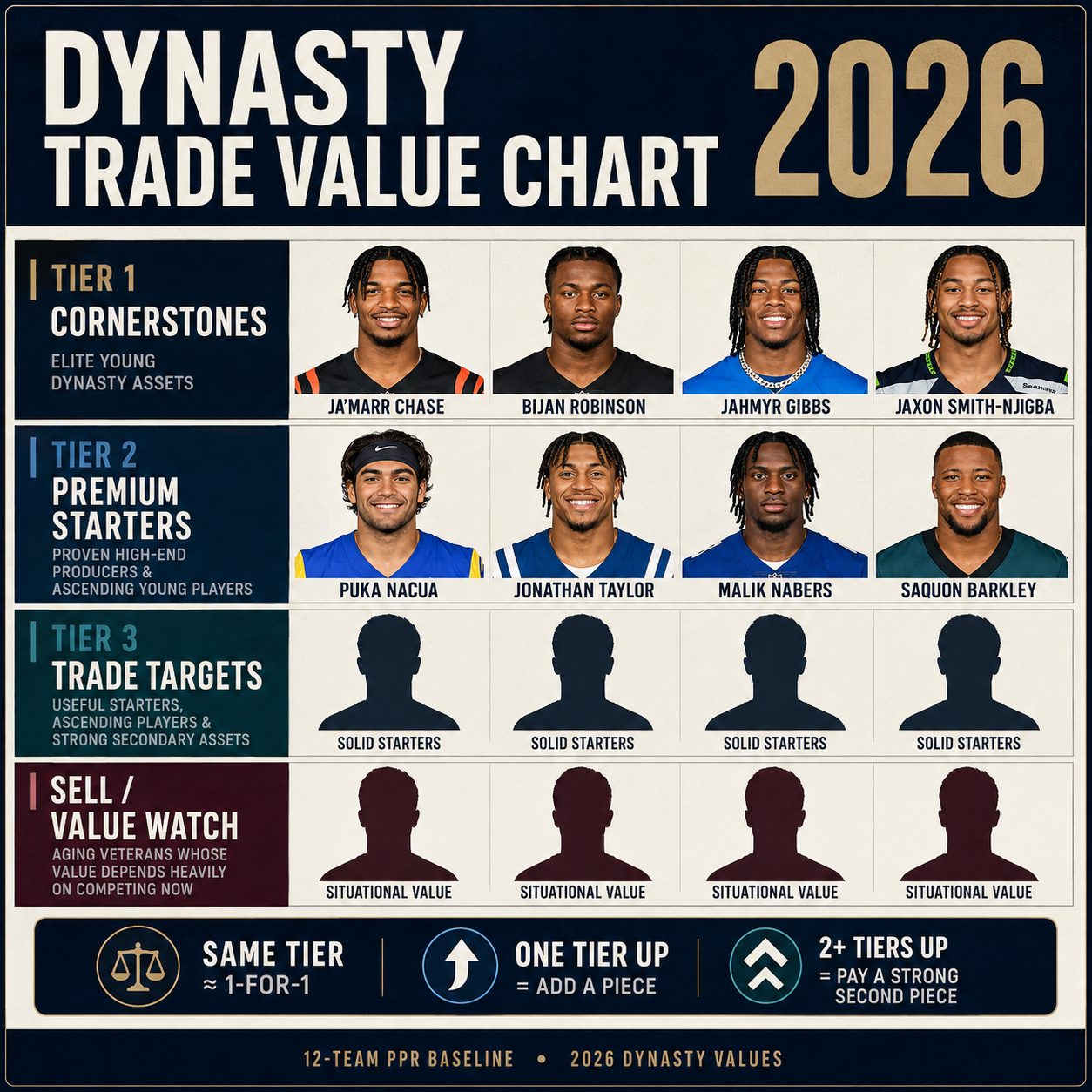
Use the tiers below to price any trade. Two players in the same tier trade roughly one for one. Moving up a tier costs you extra pieces. That is the whole game.
Prefer to plug in live numbers? Cross-reference these tiers with the exact daily values at KeepTradeCut, FantasyPros, and Draft Sharks. A guide on choosing between those three sits further down this page.
How to read this chart
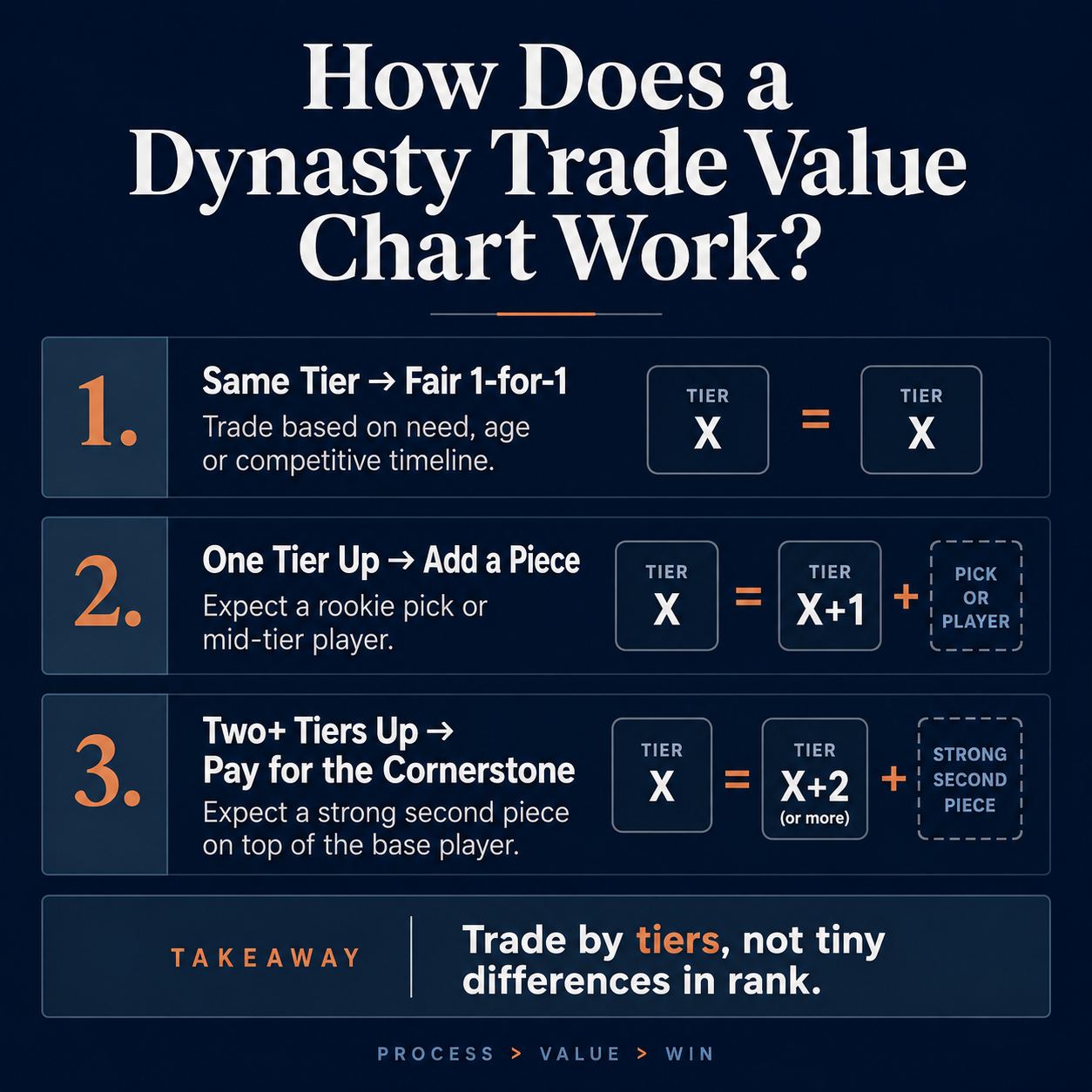
This chart sorts every fantasy-relevant player into value tiers. Tiers matter more than exact ranks. Managers who trade by tier make cleaner deals than managers who argue over one or two spots.
Here is how tiers map to real trade decisions:
- Same tier: a fair one-for-one swap. Trade for need, age, or your timeline.
- One tier up: expect to add a rookie pick or a mid-tier player to get the deal done.
- Two or more tiers up: you are buying a cornerstone. Expect to pay a strong second piece on top of a fair base.
Rookie pick values, in current market terms:
- An early 2026 first (picks 1.01 to 1.03) trades near the back of the elite young player tier.
- A mid to late first trades in line with solid tier three starters.
- A second round rookie pick trades like a bench stash with upside.
Values below assume a 12-team, PPR league. Superflex and tight end bonus scoring shift the numbers, and those adjustments are called out where they apply. Ages are listed as of the 2026 season and may be approximate.
1QB dynasty top 12 (quick reference)
For standard one quarterback leagues, here is the top of the board right now:
- Ja’Marr Chase, WR, Cincinnati
- Jaxon Smith-Njigba, WR, Seattle
- Bijan Robinson, RB, Atlanta
- Omarion Hampton, RB, Los Angeles Chargers
- Jahmyr Gibbs, RB, Detroit
- Puka Nacua, WR, Los Angeles Rams
- De’Von Achane, RB, Miami
- Amon-Ra St. Brown, WR, Detroit
- Jonathan Taylor, RB, Indianapolis
- Justin Jefferson, WR, Minnesota
- Drake London, WR, Atlanta
- Ashton Jeanty, RB, Las Vegas
Quarterbacks live lower in 1QB formats. Even the best of them rarely crack this top group, because you only start one.
Superflex dynasty top tier
Superflex leagues let you start a second quarterback in the flex. That one rule reshapes the entire chart. Now you need two starting quarterbacks to compete, so the position climbs to the top.
The Superflex anchor tier right now:
- Josh Allen, QB, Buffalo, age 30. Still the safest weekly ceiling in the game.
- Drake Maye, QB, New England, age 23. The youth case for dynasty QB1. New England added AJ Brown to raise his ceiling further.
- Jayden Daniels, QB, Washington, age 25. A dual-threat rebound candidate after an injury shortened 2025.
- Lamar Jackson, QB, Baltimore, age 29. Elite rushing floor keeps his value high.
- Jalen Hurts, QB, Philadelphia, age 27. Rushing touchdowns give him a scoring edge most passers lack.
- Joe Burrow, QB, Cincinnati, age 29. The best pure pocket passer in the tier.
- Patrick Mahomes, QB, Kansas City, age 30. Value now leans on production over remaining runway.
The Allen versus Maye debate splits the community. Managers building for the next decade lean Maye for the age. Managers who want to win now lean Allen for the proven floor. Both answers are defensible.
Dynasty quarterback tiers
Tier 1, the Superflex anchors: Josh Allen, Drake Maye, Jayden Daniels, Lamar Jackson, Jalen Hurts, Joe Burrow, Patrick Mahomes. Every one of these is a multi-year foundation in a two-quarterback league.
Tier 2, the young ascenders and steady starters: Caleb Williams (Chicago), Bo Nix (Denver), Brock Purdy (San Francisco), Justin Herbert (Los Angeles Chargers), Kyler Murray (Minnesota), Jaxson Dart (New York Giants). This tier is where smart Superflex managers shop. You get startable quarterback play without paying the anchor tax.
Tier 3, the value plays: Trevor Lawrence (Jacksonville), Dak Prescott (Dallas), Tyler Shough (New Orleans), Fernando Mendoza (rookie, Las Vegas). These names go far later than their production suggests. In Superflex, that gap is your opportunity.
The practical read: taking the QB1 at a steep cost is rarely the sharp move. Tiering down one or two spots and paying far less for similar production wins more leagues over time.
Dynasty running back tiers
Running back is the most volatile position on any dynasty chart. The value window is short. Most managers stop buying backs aggressively once they pass age 26, and the production history backs that up.
Tier 1, the young workhorses: Bijan Robinson (Atlanta, 24), Jahmyr Gibbs (Detroit, 24), De’Von Achane (Miami), Omarion Hampton (Los Angeles Chargers), Ashton Jeanty (Las Vegas). Lead backs under 25 on offences that run with intent. This is the profile you pay up for.
Tier 2, the proven lead backs and top rookie: Jonathan Taylor (Indianapolis), James Cook III (Buffalo), Chase Brown (Cincinnati), Kenneth Walker III (Kansas City), Quinshon Judkins (Cleveland), Jeremiyah Love (rookie, Arizona). Love slots here as the clear RB1 of his class.
Tier 3, the useful pieces and second-year names: Cam Skattebo (New York Giants), Travis Etienne Jr. (New Orleans), Jadarian Price (rookie, Seattle), RJ Harvey (Denver). Real starters or ascending talents with a path to more.
The sell side, ageing veterans: Saquon Barkley (Philadelphia), Derrick Henry (Baltimore), Christian McCaffrey (San Francisco). All still produce. All are on the wrong side of the age curve for a rebuild. Contenders should still pay for them. Rebuilders should move them for youth.
Pass catching work adds real value at this position. A back who catches passes stays fantasy relevant even as his rushing share fades with age.
Dynasty wide receiver tiers
Wide receiver is the backbone of most championship dynasty rosters. Receivers hold value longer than backs, with the best of them producing into their early 30s. The buy window peaks between ages 24 and 28.
Tier 1, the elite: Ja’Marr Chase (Cincinnati, 26), Jaxon Smith-Njigba (Seattle, 24), Puka Nacua (Los Angeles Rams, 25). Three receivers you can build a decade around. JSN is the youngest and has the most room left to grow.
Tier 2, the high end producers: Amon-Ra St. Brown (Detroit, 26), Malik Nabers (New York Giants, 22), Justin Jefferson (Minnesota), Drake London (Atlanta), Tetairoa McMillan (Carolina, 23), CeeDee Lamb (Dallas), Nico Collins (Houston). Nabers is the one to watch here. He is returning from a knee injury, which softened his price, and he is only 22.
Tier 3, the ascending and the steady: Carnell Tate (rookie, Tennessee), Jordyn Tyson (rookie, New Orleans), Makai Lemon (rookie, Philadelphia), Emeka Egbuka (Tampa Bay), Rome Odunze (Chicago), Brian Thomas Jr. (Jacksonville), Ladd McConkey (Los Angeles Chargers), Luther Burden III, Zay Flowers (Baltimore), George Pickens (Dallas). A deep tier full of trade targets.
Receivers under 23 carry upside and real risk in equal measure. Price them for the swing, not the certainty. Receivers past 29 belong on the sell side unless the situation is rock solid.
Dynasty tight end tiers
Tight end works differently from every other position. Genuine difference makers are scarce, and that scarcity lifts the value of the few who deliver every week.
Tier 1, the difference makers: Brock Bowers (Las Vegas), Trey McBride (Arizona). Two young tight ends who score like high-end receivers. In dynasty, that is rare enough to pay up for.
Tier 2, the strong starters: Tyler Warren (Indianapolis), Sam LaPorta (Detroit), Harold Fannin Jr. Young or ascending options who anchor the position for years.
Tier 3, the ageing and the rookie: Mark Andrews (Baltimore), George Kittle (San Francisco), Travis Kelce (Kansas City), Kenyon Sadiq (rookie, New York Jets). Kelce and the veterans are win-now assets only. Sadiq is the TE1 of the 2026 rookie class and a long-term stash.
In TEP scoring, where tight ends earn bonus points per catch, the top two climb even higher. A top three tight end in that format can carry value in the range of a strong tier two receiver.
2026 rookie pick values
The 2026 class runs deep at receiver but thin at the very top. Here is the current Superflex rookie order:
- Jeremiyah Love, RB, Arizona Cardinals. The clear 1.01. Three down back with league winning upside.
- Carnell Tate, WR, Tennessee Titans. Polished route runner with a WR1 ceiling and a Day 1 role.
- Jordyn Tyson, WR, New Orleans Saints. Big play talent, though his injury history adds risk.
- Fernando Mendoza, QB, Las Vegas Raiders. The QB1 of the class and a rising Superflex asset.
- Makai Lemon, WR, Philadelphia Eagles. Elite athletic profile in a strong offense.
- Jadarian Price, RB, Seattle Seahawks.
- KC Concepcion, WR, Cleveland Browns.
- Kenyon Sadiq, TE, New York Jets. The class TE1.
- Ty Simpson, QB, Los Angeles Rams. A patient Superflex stash behind Matthew Stafford.
In 1QB leagues, drop Mendoza and Simpson down a tier. Quarterbacks lose value the moment you can only start one.
Superflex versus 1QB: what actually changes
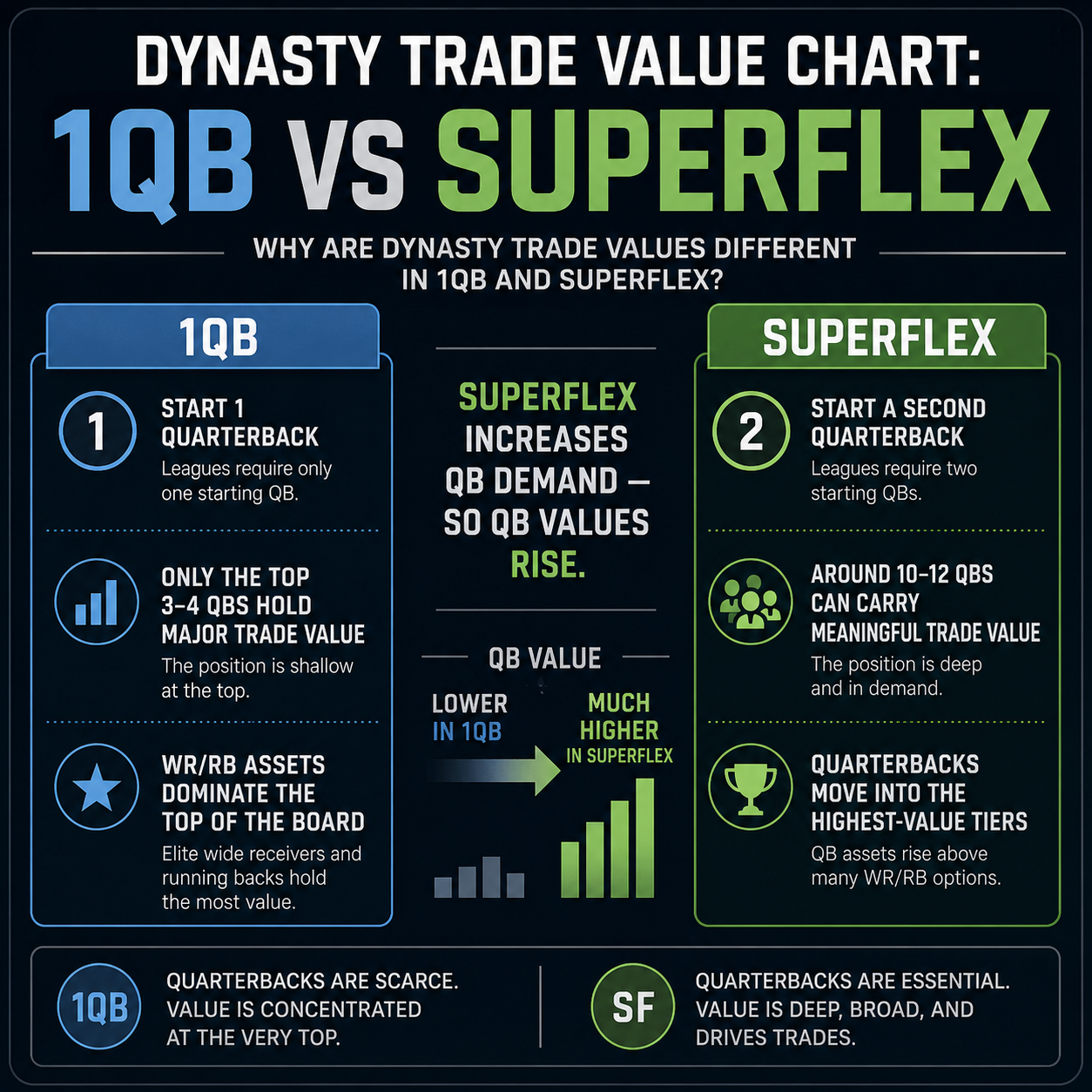
In a 1QB league, only the top three or four quarterbacks hold real trade value. Everyone else is replaceable.
In Superflex, that number stretches to ten or twelve quarterbacks with meaningful value. Every team needs two. Demand goes up, so prices go up.
The single most expensive mistake in Superflex is using 1QB values to make trades. You will overpay for receivers and running backs, and you will underpay for quarterbacks. Before you send an offer, confirm your chart is set to Superflex. The FantasyPros chart has a dedicated Superflex filter. KeepTradeCut defaults to Superflex and lets you toggle.
Which trade value chart should you actually use?
Most guides tell you to cross-reference multiple charts. Few explain how the big ones differ. Here is the honest breakdown, because the right tool depends on your league and your question.
KeepTradeCut (KTC). Crowdsourced from millions of user-submitted trade decisions, updated by the minute. Its strength is speed. When news breaks, KTC moves first, because it reflects what real managers are doing right now. Its weakness is the same thing. The crowd overreacts to hype, so young players and hot rookies can run above their true value. Best for reading live market sentiment.
FantasyPros. Built on expert consensus rankings from named analysts. Its strength is stability and a clear Superflex filter. It moves slower than the crowd, which is a feature when you want a considered number rather than a reaction. Best for a steady baseline you can trust across formats.
Draft Sharks. Uses a proprietary model, 3D Values, that blends multi-year projections with ageing curves and lets you calibrate to your exact scoring. Its strength is customisation and process. Best for managers who want values tuned to their specific league settings rather than a generic 12-team default.
How to combine them in practice. Pull the player up on all three. If the numbers agree, you have your answer. If one chart is far off from the other two, that gap is the interesting part. It usually means recent news the slower charts have not absorbed yet, or crowd hype the model is resisting. Investigate the why. That is where buy low and sell high edges live.
No single chart is correct. Reading the disagreement between them is the actual skill.
How to use these values in a real trade
Step 1. Look up both sides on more than one chart. Note where every player lands. Flag any big disagreement between sources.
Step 2. Adjust for your league rules. Superflex? Apply Superflex values. TEP? Lift the top tight ends. Full PPR versus half versus standard changes running back and receiver value, so match the chart to your scoring.
Step 3. Read your own timeline. A rebuilder and a contender should value the same player differently. Two years out from competing? Youth and picks are worth more to you. In your window right now? Proven production is worth the premium price.
Step 4. Hunt for the gap between value and reality. A player back from injury may sit below his true worth. A player fresh off a career year with unsustainable efficiency may sit above it. Trade into the first. Trade out of the second.
Step 5. Treat the chart as a starting point, not a verdict. Numbers give you structure. Context, leverage, and your roster needs determine the right call.
Visit our fantasy baseball trade simulator.
Buy low and sell high heading into 2026
Buy low: Malik Nabers, WR, New York Giants. He is returning from a knee injury, which pushed his price down, and he is only 22. The talent that produced a top-six receiver season as a rookie has not gone anywhere. If a manager in your league is nervous about the recovery, this is your window.
Buy low: Justin Jefferson, WR, Minnesota. Coming off a down year tied to shaky quarterback play. Still one of the best receivers alive. If his 2026 situation stabilises, the price you pay now looks cheap in six months.
Sell high: ageing running backs after a hot start. A back over 27 who opens the season with big numbers is a sell signal, not a hold. The market pays for recent production. Move him while it does.
Sell consideration: Drake Maye. Not a knock on the player. His 2025 efficiency led the league and is likely to cool as his schedule toughens. If a Maye manager in your league is paying full anchor price, a contender might cash that ticket and tier down.
Roster construction is where charts become a planning tool. Audit your age curve. If your best assets are all 28 and older, your window is closing. Trade aging value for a mix of proven mid tier producers and youth.
Common mistakes dynasty managers make
- Leaning on one chart. Each source has blind spots. Cross-reference KTC, FantasyPros, and Draft Sharks.
- Using 1QB values in Superflex. The fastest way to lose a quarterback trade before it starts.
- Holding aging veterans out of loyalty. The chart does not care that you drafted him. Sell before the decline, not after.
- Selling youth after a slow rookie year. Young players with good situations often struggle early, then break out. Do not move a 22-year-old off one quiet season without looking at the underlying role.
- Ignoring situation. A player’s raw value drops if he is stuck in a run-heavy offence, working back from injury, or tangled in a contract fight. Layer context on top of the number every time.
Methodology and sources
These tiers are built from a blend of current market data and expert consensus, cross-referenced across KeepTradeCut, FantasyPros, Draft Sharks, PFF, ESPN, and Footballguys as of August 12, 2026. Values reflect a 12-team PPR baseline, with Superflex and TEP adjustments noted where they apply. Player ages, teams, and injury situations reflect reporting through early August 2026.
This page updates weekly during the season. Trade values move with injuries, depth chart changes, and results, so bookmark it and check back before you send an offer.
No projected figures on this page are presented as guarantees. Dynasty values are estimates of market sentiment, not facts.
If you want to calculate dynasty trade value and estimate the trade, visit our fantasy dynasty trade value calculator.
Frequently asked questions
Who is the 1.01 in 2026 dynasty rookie drafts?
Jeremiyah Love, the Arizona Cardinals running back, is the consensus 1.01 in both Superflex and 1QB rookie drafts. He is a three-down back with a clear path to the feature role and sits in a tier of his own at the top of the class.
Is Drake Maye or Josh Allen the dynasty QB1?
It depends on your build. Josh Allen has the safer proven floor and is the pick for contenders. Drake Maye, at 23, is the long term play for rebuilders and is a defensible dynasty QB1 on age alone. Both belong in the top Superflex tier.
Should I trade for Malik Nabers coming off his knee injury?
For a rebuilding roster, yes, and the injury is why the price is reasonable. Nabers is only 22 and produced a top-six receiver season as a rookie. The main risk is the recovery timeline, so buy at a discount that accounts for it, not at full price.
How much is a 2026 first round rookie pick worth in trade?
An early 2026 first (1.01 to 1.03) trades near the back of the elite young player tier. A mid to late first trades in line with solid tier three starters. Exact values shift as the rookies play, so check a live chart before you finalise.
What is the best dynasty trade value chart for Superflex leagues?
FantasyPros offers a dedicated Superflex filter and a stable expert baseline. KeepTradeCut defaults to Superflex and updates by the minute from real trades. Use FantasyPros for a considered baseline and KTC to read live market movement. Together they cover both angles.
How often do dynasty trade values change?
Constantly. The biggest swings hit during the NFL Draft in late April, training camp in July and August, and in-season as injuries and depth charts shift. Crowdsourced tools like KeepTradeCut update in near real time. Expert charts like FantasyPros and Draft Sharks typically update weekly during the season.
Why do FantasyPros, KeepTradeCut, and Draft Sharks show different values for the same player?
Each uses a different method. KeepTradeCut aggregates real user trades, so it reacts fast and can overshoot on hype. FantasyPros blends expert rankings, so it moves slower and steadier. Draft Sharks runs a projection model with ageing curves. When they disagree, that gap usually points to fresh news or crowd overreaction, and it is worth investigating before you trade.
What makes a running back valuable on a 2026 dynasty chart?
Age and role. The most valuable dynasty backs are lead runners under 25 on teams that run often, with pass-catching work that extends their shelf life. Backs over 27 lose value fast, so avoid paying up for them unless you are contending right now.
Should I use a dynasty trade value chart differently when rebuilding versus contending?
Yes. Rebuilders should target players whose value will grow, meaning youth, upside, and picks. Contenders should target present-day production, even at a higher price and a shorter runway. The chart gives you the baseline. Your competitive window tells you what to do with it.